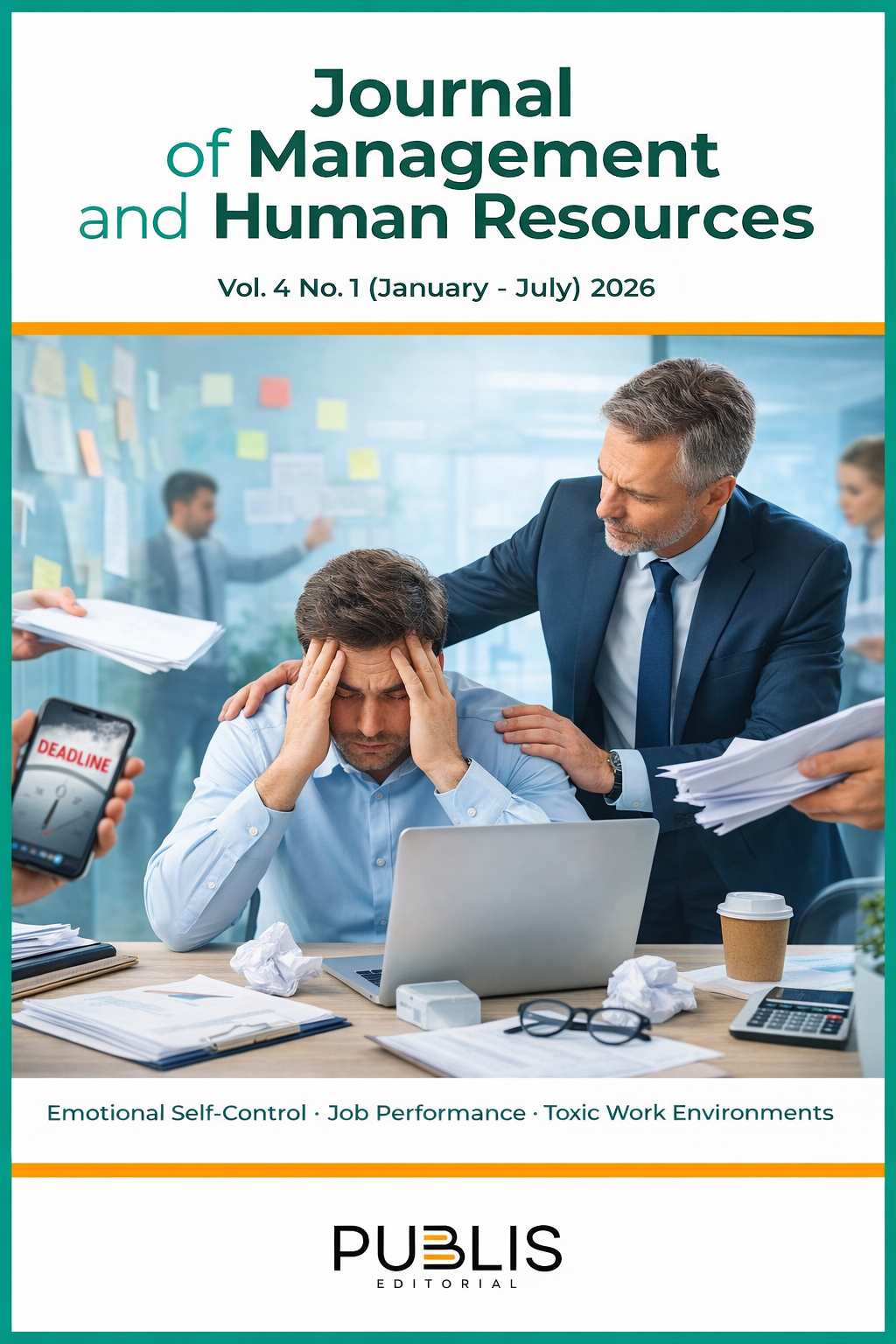
Emotional self-control and job performance in emotionally toxic organizational environments
DOI:
https://doi.org/10.5281/zenodo.18319961Keywords:
Emotional labor, Workplace well-being, Psychosocial risks, Talent management, organizational behaviorAbstract
Esta investigación tiene como objetivo analizar la influencia del autocontrol emocional en el desempeño laboral en entornos organizacionales caracterizados por dinámicas emocionalmente adversas, desde una perspectiva de gestión del talento humano. El estudio se realizó mediante una revisión bibliográfica cualitativa y exploratoria, basada en el análisis sistemático de literatura científica publicada entre 2018 y 2024 en bases de datos académicas indexadas de alto impacto. La metodología permitió identificar tendencias teóricas y empíricas relacionadas con la regulación emocional, el bienestar psicológico y el comportamiento laboral en contextos organizacionales complejos. Los resultados muestran que el autocontrol emocional actúa como un recurso psicológico clave que modula la relación entre las condiciones laborales adversas y el desempeño, contribuyendo a la reducción del estrés, el agotamiento emocional y las conductas contraproducentes. Se encuentra que el fortalecimiento de las competencias emocionales promueve un desempeño estable y el bienestar psicológico del trabajador, incluso en contextos organizacionales desfavorables. Se concluye que el autocontrol emocional es un componente estratégico para la sostenibilidad del desempeño laboral y debe integrarse en las políticas de gestión del talento humano y prevención de riesgos psicosociales.
Downloads
References
Alsomaidaee, M. M., Joumaa, B. A., & Khalid, K. W. (2023). Toxic Workplace, Mental Health and Employee Well-being, the Moderator Role of Paternalistic Leadership, an Empirical Study. Journal of Applied Business and Technology, 4(2), 114–129. https://doi.org/10.35145/JABT.V4I2.126
Anjum, A., Ming, X., Siddiqi, A. F., & Rasool, S. F. (2018). An Empirical Study Analyzing Job Productivity in Toxic Workplace Environments. International Journal of Environmental Research and Public Health, 15(5). https://doi.org/10.3390/IJERPH15051035
Bakker, A. B., & de Vries, J. D. (2021). Job Demands–Resources theory and self-regulation: new explanations and remedies for job burnout. Anxiety, Stress and Coping, 34(1), 1–21. https://doi.org/10.1080/10615806.2020.1797695;REQUESTEDJOURNAL:JOURNAL:GASC20;WGROUP:STRING:PUBLICATION
Bru-Luna, L. M., Martí-Vilar, M., Merino-Soto, C., & Cervera-Santiago, J. L. (2021). Emotional Intelligence Measures: A Systematic Review. Healthcare, 9(12), 1696. https://doi.org/10.3390/HEALTHCARE9121696
Chumpén Elera, A. C. (2024). Riesgos psicosociales y el desempeño laboral del personal administrativo en la Universidad Peruana Los Andes, Huancayo, 2023: Psychosocial risks and job performance of administrative staff at the Peruvian University Los Andes, Huancayo, 2023. LATAM Revista Latinoamericana de Ciencias Sociales y Humanidades, 5(1), 2065-2084–2065 – 2084. https://doi.org/10.56712/LATAM.V5I1.1728
Coronado-Maldonado, I., & Benítez-Márquez, M. D. (2023). Emotional intelligence, leadership, and work teams: A hybrid literature review. Heliyon, 9(10), e20356. https://doi.org/10.1016/J.HELIYON.2023.E20356
De la Cruz, P. A. C. (2019). Influencia de la Inteligencia Emocional sobre la Satisfacción Laboral en la Organización: Una Revisión de Estudios [Universidad Santiago de Cali]. https://gc.scalahed.com/recursos/files/r161r/w25729w/U3_W3.pdf
Extremera, N., Mérida-López, S., Sánchez-álvarez, N., & Quintana-Orts, C. (2018a). How Does Emotional Intelligence Make One Feel Better at Work? The Mediational Role of Work Engagement. International Journal of Environmental Research and Public Health, 15(9). https://doi.org/10.3390/IJERPH15091909
Extremera, N., Mérida-López, S., Sánchez-álvarez, N., & Quintana-Orts, C. (2018b). How Does Emotional Intelligence Make One Feel Better at Work? The Mediational Role of Work Engagement. International Journal of Environmental Research and Public Health, 15(9), 1909. https://doi.org/10.3390/IJERPH15091909
Grant, M. J., & Booth, A. (2009). A typology of reviews: an analysis of 14 review types and associated methodologies. Health Information and Libraries Journal, 26(2), 91–108. https://doi.org/10.1111/J.1471-1842.2009.00848.X
Gross, E. B. (2024). Social Work Values and the NASW Code of Ethics: Problems of Function and Possibilities for Change. Journal of Progressive Human Services, 35(3), 247–269. https://doi.org/10.1080/10428232.2025.2455883
Hernández-Sampieri, R., Fernández Collado, C., & Baptista Lucio, P. (2021). METODOLOGÍA DELA INVESTIGACIÓN.
Kaluza, A. J., Boer, D., Buengeler, C., & van Dick, R. (2020). Leadership behaviour and leader self-reported well-being: A review, integration and meta-analytic examination. Work and Stress, 34(1), 34–56. https://doi.org/10.1080/02678373.2019.1617369
Kim, N. L. T. (2024). The Impact of Emotional Intelligence and Transformational Leadership on Organizational Culture and Employee Performance in the Banking Industry in Vietnam. GLOBAL BUSINESS & FINANCE REVIEW, 29(4), 158–168. https://www.econstor.eu/bitstream/10419/305991/1/id627.pdf
Leal Paredes, S. M. (2022). Inteligencia Emocional y Compromiso Laboral en las MiPymes de Ecuador. Ciencias Administrativas, 21, 116. https://doi.org/10.24215/23143738E116
Li, M., Pérez-Díaz, P. A., Mao, Y., & Petrides, K. V. (2018). A multilevel model of teachers’ job performance: Understanding the effects of trait emotional intelligence, job satisfaction, and organizational trust. Frontiers in Psychology, 9(NOV), 412117. https://doi.org/10.3389/FPSYG.2018.02420/BIBTEX
Márquez Ortega, T. J. (2020). Clima organizacional y desempeño laboral de las instituciones públicas de educación. Ciencia y Educación, 1(4), 6–14. https://doi.org/10.48169/ECUATESIS/0104202020
Mazzetti, G., Robledo, E., Vignoli, M., Topa, G., Guglielmi, D., & Schaufeli, W. B. (2023). Work Engagement: A meta-Analysis Using the Job Demands-Resources Model. Psychological Reports, 126(3), 1069–1107. https://doi.org/10.1177/00332941211051988
Miao, C., Humphrey, R. H., & Qian, S. S. (2021). Emotional intelligence and servant leadership: A meta-analytic review. Business Ethics, 30(2), 231–243. https://doi.org/10.1111/BEER.12332;REQUESTEDJOURNAL:JOURNAL:26946424;WGROUP:STRING:PUBLICATION
O’Connor, P. J., Hill, A., Kaya, M., & Martin, B. (2019). The Measurement of Emotional Intelligence: A Critical Review of the Literature and Recommendations for Researchers and Practitioners. Frontiers in Psychology, 10(MAY), 1116. https://doi.org/10.3389/FPSYG.2019.01116
Özer, G., & Escartín, J. (2023). The making and breaking of workplace bullying perpetration: A systematic review on the antecedents, moderators, mediators, outcomes of perpetration and suggestions for organizations. Aggression and Violent Behavior, 69, 101823. https://doi.org/10.1016/J.AVB.2023.101823
Persich, M. R., Smith, R., Cloonan, S. A., Woods-Lubbert, R., Strong, M., & Killgore, W. D. S. (2021). Emotional intelligence training as a protective factor for mental health during the COVID‐19 pandemic. Depression and Anxiety, 38(10), 1018. https://doi.org/10.1002/DA.23202
Ramadhona, P., Erlina, E., & Jimad, H. (2022). Effect of Emotional Intelligence and Transformational Leadership on Employee Performance Mediated by Employee Job Satisfaction. International Journal of Economics, Business, and Entrepreneurship, 5(2), 58–68. https://doi.org/10.23960/IJEBE.V5I2.195
Rasool, S. F., Wang, M., Tang, M., Saeed, A., & Iqbal, J. (2021). How Toxic Workplace Environment Effects the Employee Engagement: The Mediating Role of Organizational Support and Employee Wellbeing. International Journal of Environmental Research and Public Health, 18(5), 2294. https://doi.org/10.3390/IJERPH18052294
Ruíz, M. (2023). LOS CUATRO ACUERDOS: Un libro de la Sabiduría Tolteca (18° ed.). Urano . www.nuevagaia.com
Sáenz-Cavia, A., & Delfino, G. (2025). Inteligencia Emocional: Concepto, Definición y Enfoques. ANUARIO DE INVESTIGACIONES , 375–382. https://www.psi.uba.ar/publicaciones/anuario/trabajos_completos/31/saenz_cavia.pdf
Salanova, M., Llorens, S., & Martínez, I. M. (2016). Aportaciones desde la psicología organizacional positiva para desarrollar organizaciones saludables y resilientes contributions from positive organizational psychology to develop healthy and resilient organizations. Papeles Del Psicólogo , 37(3), 177–184. https://www.papelesdelpsicologo.es/pdf/2773.pdf
Segura Lozano, X., Flores Álvarez, L. N., Fuantos Nuñez, J. T., Cruz Pecina, H. E., & Peña López, J. E. (2025). Impacto del estrés laboral prolongado en la salud mental de los trabajadores en entornos organizacionales: Impact of prolonged work stress on the mental health of workers in organizational settings. LATAM Revista Latinoamericana de Ciencias Sociales y Humanidades, 6(3), 2084-2096–2084 – 2096. https://doi.org/10.56712/LATAM.V6I3.4095
Sistiaga, S., Bodart, A., Sequeira, H., & Campanella, S. (2025). Emotion Regulation Assessment: A New Perspective Using Simultaneous Electroencephalographic and Electrodermal Recordings. Clinical EEG and Neuroscience, 56(4), 295–304. https://doi.org/10.1177/15500594241302553
Zhu, D., Doan, T., Kanjanakan, P., & Kim, P. B. (2022). The impact of emotional intelligence on hospitality employees’ work outcomes: a systematic and meta-analytical review. Journal of Hospitality Marketing and Management, 31(3), 326–347. https://doi.org/10.1080/19368623.2021.1978914
Published
Data Availability Statement
The datasets used and/or analyzed during the current study are available from the corresponding author on reasonable request.
Issue
Section
License
Copyright (c) 2026 Gladys Jahaira Bustos Andrade, Juan M Gómez (Author)

This work is licensed under a Creative Commons Attribution-NonCommercial-ShareAlike 4.0 International License.